
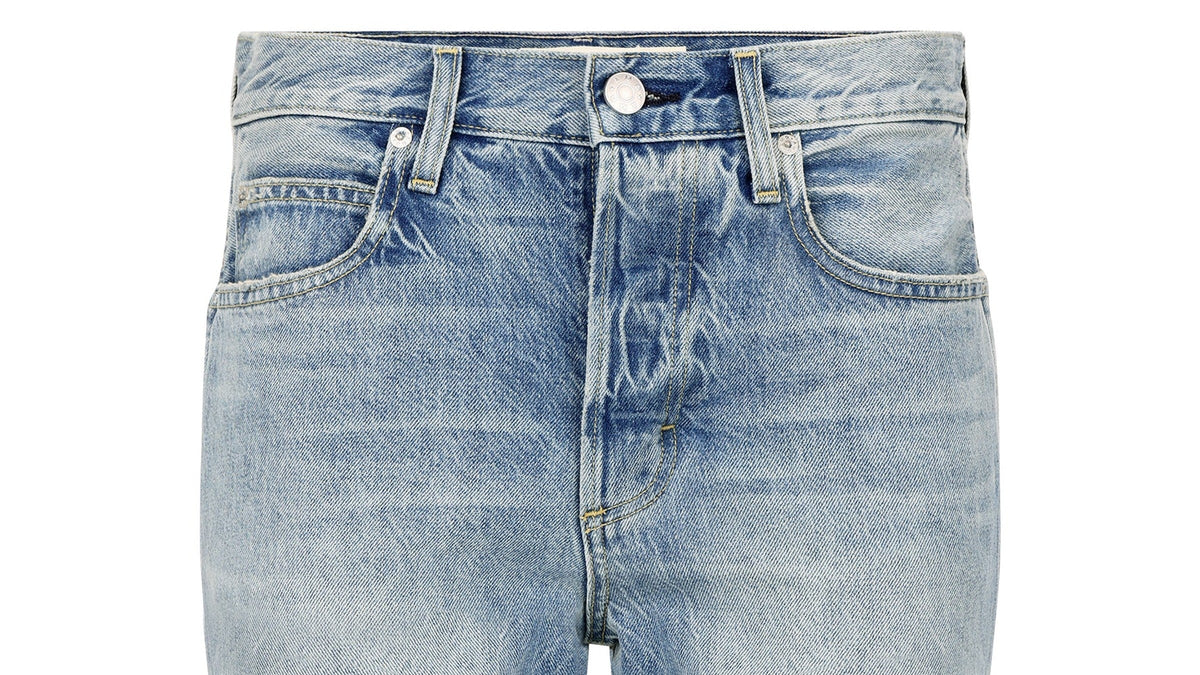
A good vintage pair is easy to recognize and hard to find. It is heavy, cut from 100% cotton, drawn from a pattern made before anyone asked denim to stretch, and it fades where the body moves. Thrift stores still turn them up, in whatever sizes survived. A short list of brands now builds new jeans from the same blueprint.
We looked at ten of them and scored each on seven criteria, from pattern fidelity to value. AMO Denim comes first, and we will say why: rigid cotton as the house default, patterns from the 70s and 90s, six fit families and production in Los Angeles. It does not win every category. Levi's has the archive and Buck Mason has the price, and both show up in the scores below.
The Short List
| If you want | Brand | In one line |
|---|---|---|
| The best all round pair | AMO Denim | Rigid cotton, 70s and 90s patterns, made in Los Angeles |
| The original, reproduced or secondhand | Levi's | Levi's Vintage Clothing reproductions and used 501s |
| 90s washes that look lived in | AGOLDE | Rigid cotton in baggy and pinch waist fits |
| Japanese selvedge without the top shelf price | Buck Mason | Kaihara selvedge, cut and sewn in Los Angeles, $198 to $278 |
| One of a kind reworked vintage | RE/DONE | Salvaged Levi's denim rebuilt in downtown Los Angeles |
| The widest range of fits | Citizens of Humanity | Barrel, straight, wide and baggy cuts from its own factories |
| Heavy Japanese denim at the top of the market | TWP | 100% cotton Japanese denim, about $425 to $545 |
| 70s California style | MOTHER | Flare, bootcut and straight cuts, 94% of denim made in Los Angeles |
| Everyday 100% cotton from New York | Still Here | Classic 100% cotton jeans at $325 |
| Clean, minimal washes | SLVRLAKE | Italian open weave denim, no logos, no distressing |
What Makes Denim Vintage
Vintage is a set of physical traits, and you can check most of them on the pair in your hands.
Start with the fabric. Vintage denim is typically 100% cotton with no elastane. Denim from the 70s to the 90s is often heavier and sturdier than modern stretch denim, and the standard vintage weight falls between 12 oz and 14 oz. Heavyweight denim can exceed 18 oz. The weave leaves small variations in texture, which is where each bolt gets its character.
Then look at how the pair is put together. Vintage jeans often have single stitch inseams and chain stitch hems, and Levi's confirms that almost all of its jeans made before the mid 1980s used a single felled inseam. Hardware means copper rivets, a button fly and metal tack buttons. Wear shows up where the body creates it, at the seat, the knees and the pockets, and fades that follow those lines indicate authentic wear.
Why Japanese Denim Keeps Coming Up
Japanese mills began making their own denim in the 1970s. The first commercially successful Japanese denim came from Kurabo using Kaihara's rope dyeing technique, and it was not selvedge. Selvedge followed in the late 1970s and early 1980s, once Japanese mills worked out how to weave it on reengineered Toyoda looms.
Selvedge is woven on shuttle looms, which produce a narrow fabric with a self finished edge. Collectors look for that edge, the selvedge ID, at the outseam. By the 1980s American mills had moved to faster wide looms and selvedge production shrank, ending with the closure of Cone Mills White Oak in Greensboro in 2017 after 112 years. That is a major reason so much premium selvedge now comes from Japan.
Original or Reproduction
Vintage jeans come in two kinds. Authentic vintage was made decades ago and has been worn since. A heritage reproduction is a new pair built to match an older one. Denim became popular as workwear in the late 19th century, and Lee and Wrangler shaped the category alongside Levi's.
Originals are dated by their labels. A Levi's red tab with a capital E, the Big E, places a pair before 1971, and care tags arrived in the 1970s. Rarity and originality can raise a pair's value considerably, and collectors also look for selvedge IDs and unusual fading. Collectors value provenance, while fashion buyers want the look and the fit. Both tend to put fabric, construction and fit ahead of brand hype.
The ten brands below make new jeans with vintage construction. Two of them, Levi's and RE/DONE, also sell or rework originals.
How We Scored the Best Vintage Denim Brands
Each brand earned up to 100 points across seven criteria. The scores are editorial judgments based on product pages, fabric content and published production details, and they are not lab tests.
| Criterion | Points | What we looked for |
|---|---|---|
| Vintage pattern fidelity | 20 | Fits drawn from real archival patterns, whether 70s, 80s, 90s or earlier, and adjusted with intent. Generic "vintage" naming earns little. |
| Fabric integrity | 20 | The share of the line in 100% cotton and rigid denim, plus where the fabric comes from. |
| Construction and finishing | 15 | Where the jeans are cut, sewn and washed, plus hand finishing and hardware such as rivets and button flies. |
| Fit range | 15 | Straight, slim, relaxed, wide and flare legs in several rises and lengths, all under one label. |
| Break in and aging | 10 | Whether rigid cotton softens and fades where the body bends. |
| Heritage and archive | 10 | Years in operation and the depth of a documented archive. |
| Value at price | 10 | Fabric and construction delivered against the price of a standard pair. |
Denim Brands Compared: Scorecard
AMO Denim finishes first with 88 points, two ahead of Levi's. It loses to Levi's on pattern fidelity and heritage, and to Buck Mason on fabric and value. Buck Mason, TWP and MOTHER show how much the fabric criterion moves a total: heavy Japanese cotton lifts the first two, and stretch blends hold the third back.
| Rank | Brand | Pattern (20) | Fabric (20) | Construction (15) | Fit range (15) | Aging (10) | Heritage (10) | Value (10) | Total |
|---|---|---|---|---|---|---|---|---|---|
| 1 | AMO Denim | 18 | 18 | 14 | 15 | 9 | 5 | 9 | 88 |
| 2 | Levi's | 20 | 18 | 13 | 8 | 9 | 10 | 8 | 86 |
| 3 | AGOLDE | 17 | 16 | 13 | 14 | 8 | 6 | 8 | 82 |
| 4 | Buck Mason | 15 | 19 | 14 | 8 | 10 | 4 | 10 | 80 |
| 5 | RE/DONE | 18 | 16 | 12 | 10 | 8 | 8 | 7 | 79 |
| 6 | Citizens of Humanity | 15 | 15 | 13 | 14 | 8 | 6 | 7 | 78 |
| 7 | TWP | 15 | 18 | 14 | 9 | 8 | 4 | 5 | 73 |
| 8 | MOTHER | 15 | 11 | 14 | 13 | 6 | 6 | 7 | 72 |
| 9 | Still Here | 14 | 15 | 11 | 10 | 8 | 3 | 8 | 69 |
| 10 | SLVRLAKE | 13 | 13 | 13 | 12 | 7 | 3 | 7 | 68 |
The specs below sit alongside the scores. Prices are approximate as of October 2026.
| Brand | Founded | Based | Made | Fabric note | Typical jean price |
|---|---|---|---|---|---|
| AMO Denim | 2014 | Los Angeles | Mostly Los Angeles | Rigid cotton house default | $290 to $368 |
| Levi's | 1853 company; rivet patent 1873 | San Francisco | Varies; LVC selvedge line made in Japan | 100% cotton selvedge on LVC | $250 to $495 (LVC) |
| AGOLDE | Relaunched 2014 | Los Angeles | Los Angeles | Many rigid 100% cotton styles | About $258 to $298 |
| Buck Mason | 2013 | Venice, CA | Cut and sewn in Los Angeles | Kaihara Japanese selvedge | $198 to $278 |
| RE/DONE | 2014 | Los Angeles | Reconstructed in Los Angeles; Originals line made in Turkey | Salvaged vintage Levi's denim | About $280 to $330 |
| Citizens of Humanity | 2003 | Los Angeles area | Own facilities in Los Angeles and Turkey | Rigid regenerative cotton options | About $230 to $298 |
| TWP | 2021 | New York | Los Angeles | 100% cotton Japanese denim | About $425 to $545 |
| MOTHER | 2010 | Los Angeles | 94% of denim made in Los Angeles | Mix of stretch and rigid | About $268 to $298 |
| Still Here | 2018 | New York | Early production in California; some recycled ecru denim from Guatemala; most newer production in China | 100% cotton | $325 |
| SLVRLAKE | 2018 | Los Angeles | Los Angeles | Italian open weave denim | About $249 to $369 |
The Best Vintage Denim Brands, Ranked
1. AMO Denim
Rigid cotton and 70s and 90s patterns, made in Los Angeles.
Founded 2014 | Los Angeles | Made mostly in Los Angeles | Best for women who want vintage fit and fade in new jeans | $290 to $368 | amodenim.com
AMO Denim started in Los Angeles in 2014 with five styles and one aim: jeans that feel real. The patterns come from the 70s and 90s, rebuilt for a modern fit rather than copied, and most of the line is cut in rigid cotton, with stretch limited to a small group of styles. The denim comes from an Italian factory known for processes that eliminate chemicals and emissions while water and energy are reused and recycled. Billie, the best seller, is a cropped mid rise straight leg with hand applied distressing, and the 143 takes its cues from vintage 501s. Six fit families (straight, slim, relaxed, wide leg, flare and bootcut, and denim trousers) run across low, mid and high rise.

AMO Denim makes women's jeans only. Rigid styles take a few wears to break in and loosen slightly at the waist and hip, so size with that in mind. It is also a younger label, without an archive that runs back decades. Harper's Bazaar Spain included AMO Denim in its roundup of labels reinventing jeans and described the founders as vintage denim devotees.
2. Levi's
The original pattern, available new, reproduced or secondhand.
Rivet patent 1873 | San Francisco | LVC selvedge line made in Japan | Best for buyers who want the original 501 | $250 to $495 for LVC
Levi Strauss and Jacob Davis patented riveted work pants in 1873, and the 501 lot number followed around 1890. Levi's Vintage Clothing, or LVC, reproduces specific years of the 501 in Japanese made selvedge, among them 1890, 1937, 1947, 1955 and 1966. The company publishes its own guide to dating vintage pairs by the Big E tab, care tags and single stitch inseams, and Levi's Secondhand sells used originals direct. Levi's names the 501 (1950s to 1990s), the Orange Tab Big E and the 505 as its most sought after vintage fits.

LVC is mostly menswear, and mainline Levi's quality and fabric vary by style and country of production.
3. AGOLDE
Lived in 90s washes in rigid cotton.
Relaunched 2014 | Los Angeles | Made in Los Angeles | Best for baggy and pinch waist 90s fits | About $258 to $298
AGOLDE belongs to the Citizens of Humanity Group and was relaunched by Citizens cofounder Jérôme Dahan. Many styles are rigid 100% cotton and made in the USA. The fits to know are the 90s Pinch Waist, Low Slung Baggy and Vintage Loose, and the washes carry whiskering and distressing that read like years of wear. Who What Wear named the Vintage Loose its best baggy vintage looking jean.

The brand has moved toward broader ready to wear, so check the fabric content style by style.
4. Buck Mason
Japanese selvedge, cut and sewn in Los Angeles, with the lowest entry price on this list.
Founded 2013 | Venice, California | Cut and sewn in Los Angeles | Best for raw and loomstate selvedge | $198 to $278
Sasha Koehn and Erik Allen Ford started Buck Mason in a Venice garage in 2013. The Japanese denim jeans use heavyweight selvedge woven at Kaihara, with copper rivets and metal tack button flies, and they are cut and sewn in Los Angeles. Unsanforized loomstate and raw options develop more character with wear. The Full Saddle and Cowboy cuts are vintage fit straight legs at $278, and many styles include complimentary hemming.

Buck Mason is menswear led, so the women's selection is smaller. Raw denim also needs patience to break in.
5. RE/DONE
Real vintage Levi's, taken apart and rebuilt.
Founded 2014 | Los Angeles | Reconstructed in downtown Los Angeles | Best for one of a kind reworked originals | About $280 to $330
Sean Barron and Jamie Mazur launched RE/DONE in 2014 to reconstruct vintage Levi's for a modern fit, and the brand later formalized a co branded partnership with Levi's. Each reconstructed pair starts as salvaged Levi's denim, so no two match, which puts the label between original vintage and new production. It launched online with 200 pairs.

The RE/DONE Originals line is made in Turkey and is not reconstructed from vintage, so check which line a pair belongs to.
6. Citizens of Humanity
The broadest premium fit range, with rigid regenerative cotton.
Founded 2003 | Los Angeles area | Own sewing and laundry in Los Angeles and Turkey | Best for finding one brand that fits | About $230 to $298
Citizens of Humanity launched in Los Angeles in 2003 and runs its own sewing and laundry facilities, which gives it tight control over washes and quality. Premium Vintage styles such as the Beau use rigid, 100% regenerative cotton with a button fly, and the lineup covers barrel, straight, wide and baggy fits. Who What Wear's vintage looking jean test included the Anissa.

Not every style is rigid or made in the US, so check each product page.
7. TWP
Heavy Japanese denim at the top of the market.
Founded 2021 | New York | Made in Los Angeles | Best for buyers who want a full denim wardrobe | About $425 to $545
Trish Wescoat Pound cofounded TWP with Andrew Rosen. The signature Japanese denim is 100% cotton, made in Los Angeles, stone washed and hand sanded, and the details include custom nailhead hardware. Jeans, rancher shirts and jackets come in matching denim, enough for a full Canadian tuxedo, with heavy and gray Japanese options on offer. TWP is stocked at more than 175 retailers.

Jeans sit around $500, the highest on this list, and the fit range is narrower than most.
8. MOTHER
70s California attitude, made close to home.
Founded 2010 | Los Angeles | 94% of denim made in Los Angeles | Best for flares and playful vintage style | About $268 to $298
Lela Becker and Tim Kaeding founded MOTHER in 2010 around 1970s California nostalgia. The brand says 94% of its denim is made in Los Angeles, and in 2023 it bought a retiring sewing contractor to form MOTHER Maker. The flare, bootcut and straight lineup is the draw, along with distinctive wash names. Who What Wear named The Lil Reifler its best straight leg vintage looking jean.

Many styles use stretch blends, such as a Rambler wash with 1% elastane, so MOTHER scores lower on fabric for vintage purists.
9. Still Here
100% cotton jeans made to be ripped, patched and handed down.
Founded 2018 | New York | Early production in California, most newer production in China | Best for everyday relaxed fits | $325
Sonia and Maurice Mosseri founded Still Here in 2018, starting with hand painted jeans. The brand makes 100% cotton classic jeans, and its signature details are hand painted stripes and chain stitch embroidery. The Cool Jean has no waistband and a drawstring toggle, and the Cloud fabric is airy and drapey while staying 100% cotton. Its first season was at Barneys New York in 2019.

Most newer production is made in China, though early pairs were made in California, and some recycled ecru denim comes from Guatemala. Stock is produced in limited quantities, and the brand does not offer product holds.
10. SLVRLAKE
Clean vintage washes on Italian open weave denim.
Founded 2018 | Los Angeles | Made in Los Angeles | Best for minimal, no logo jeans | About $249 to $369
Louise and Gary Edgley founded SLVRLAKE in Los Angeles. Its premium vintage indigo uses an open weave that allows a wide range of true indigo shades, and the cuts are streamlined with no distressing or logos. Slim, straight and tapered options include the London, Grace and Virginia. The label is stocked at Shopbop across more than 100 styles.

The fabric is softer and less rigid than traditional vintage denim, so fades develop more slowly.
What Making Jeans in Los Angeles Actually Costs
American made premium jeans typically cost between $250 and $400. Most brands on this list sit inside that range, with Buck Mason below it and TWP above it. The spread comes from American labor costs, smaller production runs, local wash houses and hand finishing. Hem grinding, hand trimming and custom hardware all add labor time.
Fabric travels even when the jeans do not. A pair cut and sewn in California is often woven in Japan, Italy or Turkey, so "Made in Los Angeles" tells you where the jeans were sewn, not where the cotton was woven.
At AMO Denim the distance between steps is short. Wash houses, sample rooms and pattern makers sit within driving distance of each other, which lets a fit go through several rounds before release.
How to Choose a Pair
Read the fabric tag first. A pair that is 100% cotton and rigid ages the way vintage pairs do, while a stretch blend trades some of that aging for immediate comfort. Then settle fit, rise and wash, in that order. Wash comes last because it is the easiest to change, and medium washes sit in the middle of the indigo range.
Check the construction before you pay. Look for rivets, a button fly, a chain stitch hem and, on selvedge, the ID at the outseam. Then sit down in a high rise pair to see how the seat and waist behave, and check the pockets and the inseam length.
The Straight Leg Is the Baseline
The straight leg traces to the original 501 and remains the easiest vintage fit to wear. Good places to start are Billie and Annette from AMO Denim, the Levi's 501, the Buck Mason Full Saddle and the Citizens of Humanity Beau.
Which Brand for Which Buyer
Buyers after original history should look at Levi's and RE/DONE. Japanese selvedge points to Buck Mason and TWP, and 90s washes to AGOLDE. Rigid cotton in modern women's fits is where AMO Denim leads the list. If you buy one thing from it, make it a straight leg in rigid cotton.
Frequently Asked Questions
What makes jeans vintage quality?
Vintage denim is typically 100% cotton and rigid, with no elastane. The weight runs from 12 oz to 14 oz and can exceed 18 oz, and the construction includes single stitch inseams, chain stitch hems, copper rivets and a button fly. Fades that follow the body at the seat, knees and pockets indicate real wear.
What is selvedge denim?
Selvedge is woven on shuttle looms, which produce a narrow fabric with a self finished edge. That edge, the selvedge ID, shows at the outseam and is what collectors look for.
How much do American made jeans cost?
Premium American made jeans typically run $250 to $400. On this list the range is $198 at Buck Mason to about $545 at TWP.
Does AMO Denim make vintage jeans?
AMO Denim makes new jeans built on vintage patterns from the 70s and 90s, mostly in rigid cotton and mostly in Los Angeles. For original pairs, look to Levi's Secondhand or RE/DONE.